

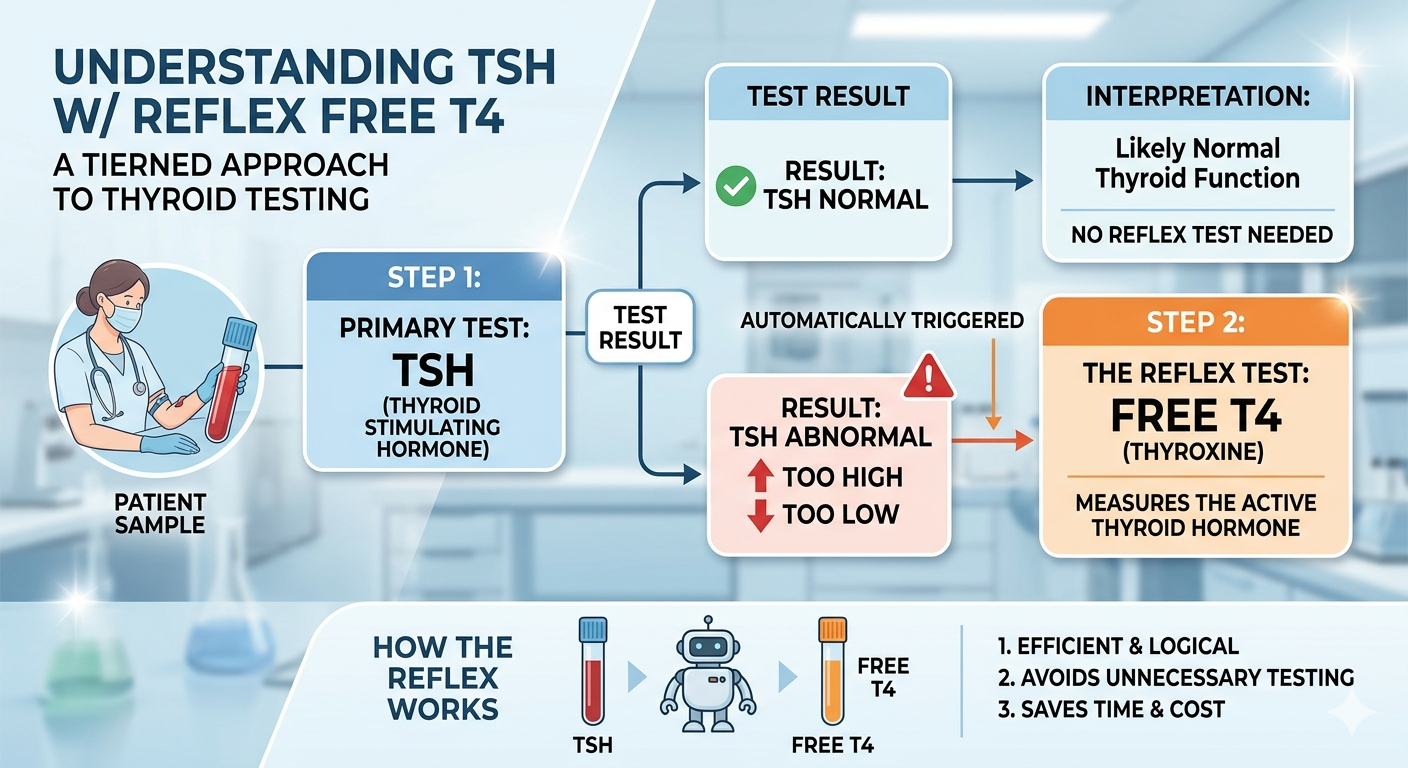
Navigating the world of medical laboratory testing can often feel like trying to decipher a foreign language. One of the most common yet confusing orders patients see on their blood work is the thyroid panel, specifically the line that asks, what is tsh w reflex free t4? At its simplest, this test is an efficient, two-step process designed to evaluate how well your thyroid gland is functioning. Instead of running multiple expensive tests all at once, the laboratory starts with a primary screening tool—the Thyroid Stimulating Hormone (TSH). If that initial result falls outside of the normal range, the “reflex” action triggers an automatic secondary test: the Free Thyroxine (T4).
- The Biological Mechanics of the Thyroid
- Understanding the “Reflex” Logic in Lab Testing
- Interpreting the Numbers: What is TSH w Reflex Free T4 Telling Us?
- Symptoms that Prompt the Question: What is TSH w Reflex Free T4?
- Common Factors That Influence Thyroid Lab Results
- The Importance of the Pituitary-Thyroid Axis
- Preparing for Your Blood Test
- Practical Implications for Patients
- Conclusion: Taking Control of Your Endocrine Health
- Frequently Asked Questions (FAQs)
The thyroid gland is a butterfly-shaped organ located in the base of your neck that acts as the master controller for your body’s metabolism. Every cell in your body relies on thyroid hormones to determine how quickly it should function. When a doctor orders this specific panel, they are looking for a comprehensive snapshot of your endocrine health. Understanding what is tsh w reflex free t4 helps patients realize that this isn’t just one test, but a smart diagnostic strategy that saves both time and medical resources while providing the most accurate data possible.
The Biological Mechanics of the Thyroid
To truly grasp what is tsh w reflex free t4, we must first look at the communication system between the brain and the thyroid gland. This relationship is often compared to a thermostat and a furnace. The pituitary gland, located at the base of your brain, acts as the thermostat. It monitors the levels of thyroid hormone in your bloodstream. If the levels are too low, the pituitary gland “turns up the heat” by releasing TSH. This hormone travels through the blood to the thyroid, signaling it to produce more T4.
Conversely, if there is too much thyroid hormone in the system, the pituitary gland slows down the production of TSH. This feedback loop is remarkably precise. Because TSH is so sensitive to even minor changes in thyroid hormone levels, it is considered the gold standard for initial screening. When you ask your healthcare provider what is tsh w reflex free t4, you are essentially asking about the status of this delicate communication line.
Key Insight for Patients: > TSH is not actually a thyroid hormone; it is a pituitary hormone. It reflects how hard your brain is trying to push your thyroid to work. Therefore, a high TSH often indicates an underactive thyroid (Hypothyroidism), not an overactive one.
Understanding the “Reflex” Logic in Lab Testing
The “reflex” portion of the test is where the efficiency of modern medicine shines. In many traditional lab orders, a doctor might check off several boxes for TSH, Free T4, and Free T3. However, if the TSH comes back perfectly normal, the other tests are often redundant because they likely wouldn’t show an abnormality anyway. By specifically requesting what is tsh w reflex free t4, the physician is telling the lab: “Check the TSH first. If it’s normal, stop there. If it’s high or low, automatically check the Free T4 to see why.“
This “if-then” logic is beneficial for several reasons. First, it reduces the cost for the patient and the insurance provider. Second, it requires less blood volume in some cases. Third, it ensures that the doctor has all the necessary follow-up data ready by the time they review the results with the patient. When exploring what is tsh w reflex free t4, it is clear that the “reflex” is a safeguard against incomplete diagnostic information.
-
Initial Step: The lab measures the TSH level in the blood sample.
-
The Threshold: If TSH is within the laboratory’s established “Normal Range,” the test concludes.
-
The Reflex Action: If TSH is above or below the range, the lab automatically uses the remaining blood to measure Free T4.
-
Final Report: The clinician receives a report that explains both the brain’s signal (TSH) and the thyroid’s response (T4).
Interpreting the Numbers: What is TSH w Reflex Free T4 Telling Us?
Once the results are in, the combination of high and low numbers tells a specific story about your internal health. To understand what is tsh w reflex free t4 in terms of actual numbers, we have to look at the two most common thyroid conditions: Hypothyroidism and Hyperthyroidism.
High TSH and Low Free T4 (Hypothyroidism)
In this scenario, the pituitary gland is screaming (High TSH) for more hormone, but the thyroid gland is failing to produce it (Low Free T4). This is classic primary hypothyroidism. Patients often feel sluggish, cold, and experience weight gain because their metabolism has essentially slowed down to a crawl.
More Read



Low TSH and High Free T4 (Hyperthyroidism)
Here, the pituitary has almost completely stopped sending signals (Low TSH) because there is already way too much hormone in the blood (High Free T4). This indicates an overactive thyroid. This condition can lead to a rapid heart rate, anxiety, and unintended weight loss.
Pro Tip: > Sometimes the reflex test uncovers “Subclinical” issues. For example, if your TSH is slightly high but your Free T4 is still in the normal range, it may indicate the very early stages of thyroid failure. Knowing what is tsh w reflex free t4 helps you catch these subtle trends before they become major health crises.
Symptoms that Prompt the Question: What is TSH w Reflex Free T4?
Most people don’t go looking for thyroid tests unless they feel “off.” Because the thyroid affects almost every organ system, the symptoms of an imbalance can be incredibly diverse. When a patient presents with vague complaints of fatigue or mood changes, the doctor often investigates by checking what is tsh w reflex free t4.
Hypothyroid Symptoms (Underactive)
-
Unexplained weight gain or difficulty losing weight.
-
Persistent fatigue and sleeping more than usual.
-
Dry skin, brittle hair, and thinning eyebrows.
-
Increased sensitivity to cold temperatures.
-
Depression or “brain fog.“
Hyperthyroid Symptoms (Overactive)
-
Sudden weight loss despite an increased appetite.
-
Rapid or irregular heartbeat (palpitations).
-
Nervousness, irritability, or tremors in the hands.
-
Excessive sweating and heat intolerance.
-
Changes in bowel patterns (more frequent movements).
Identifying these symptoms early is the best way to utilize the diagnostic power of the thyroid panel. By understanding what is tsh w reflex free t4, you can better communicate with your doctor about which specific symptoms match your lab values.
Common Factors That Influence Thyroid Lab Results
It is important to realize that several external factors can interfere with the accuracy of your thyroid tests. When discussing what is tsh w reflex free t4 with your endocrinologist, you should mention any supplements or medications you are currently taking.
One of the biggest culprits in modern lab interference is Biotin (Vitamin B7). Many high-dose hair, skin, and nail supplements contain enough Biotin to falsely lower TSH levels and falsely raise T4 levels. This can make a perfectly healthy person look like they have hyperthyroidism on paper. Experts recommend stopping Biotin supplements at least three to five days before undergoing a test that determines what is tsh w reflex free t4.
Other factors include:
-
Pregnancy: Hormonal shifts during pregnancy naturally alter TSH ranges.
-
Severe Illness: Sometimes called “Euthyroid Sick Syndrome,” the body may temporarily lower thyroid function during a major trauma or infection.
-
Time of Day: TSH levels follow a circadian rhythm and are typically highest in the early morning.
-
Medications: Steroids, certain heart medications (like Amiodarone), and lithium can all impact the results of what is tsh w reflex free t4.
The Importance of the Pituitary-Thyroid Axis
The “Axis” is the term doctors use for the complex communication network we’ve been discussing. When you ask what is tsh w reflex free t4, you are looking at the feedback loop in action. This axis is vital for maintaining “Homeostasis”—the state of steady internal conditions.
If the pituitary gland itself is damaged (Secondary Hypothyroidism), it might not produce enough TSH even when thyroid hormone levels are low. In this rare case, the “reflex” might not trigger because the TSH looks “normal” or “low-normal,” but the patient is actually hypothyroid. This is why it is so important for doctors to treat the patient, not just the paper. If you have severe symptoms but your result for what is tsh w reflex free t4 comes back within range, you might need a more specialized “Full Thyroid Panel” that includes Free T3 and Thyroid Antibodies.
Preparing for Your Blood Test
To ensure that the answer to what is tsh w reflex free t4 is as accurate as possible, proper preparation is key. While you don’t always need to fast for a thyroid test, many doctors prefer it to keep other metabolic markers stable.
The most important step is consistency. If you are already taking thyroid medication (like Levothyroxine), ask your doctor if you should take it before or after the blood draw. Usually, it is best to wait until after the blood is drawn so the lab measures your baseline levels rather than the peak level of the medication in your system. This ensures the most reliable interpretation of what is tsh w reflex free t4.
-
Timing: Try to get your blood drawn between 7 AM and 9 AM for the most consistent TSH readings.
-
Hydration: Drink plenty of water before the draw to make the vein access easier for the phlebotomist.
-
Supplement Check: Discontinue Biotin and check with your doctor about other non-essential vitamins.
Practical Implications for Patients
In the modern healthcare system, being an informed patient is your best defense. When you see what is tsh w reflex free t4 on your portal, you now know that you are looking at a smart, layered defense against disease. This test allows for early intervention. Left untreated, thyroid issues can lead to heart disease, high cholesterol, and in extreme cases, a life-threatening condition called “Myxedema Coma” (for hypo) or “Thyroid Storm” (for hyper).
By staying on top of these numbers, you can work with your physician to fine-tune your treatment. Thyroid health is not a “set it and forget it” situation; it often requires lifelong monitoring and occasional dose adjustments. Understanding what is tsh w reflex free t4 empowers you to be an active participant in that process rather than a passive observer.
Conclusion: Taking Control of Your Endocrine Health
In conclusion, understanding what is tsh w reflex free t4 is a vital part of managing your overall wellness. This test stands as a model of medical efficiency, ensuring that the most sensitive markers of thyroid health are checked first, with a built-in safety net to explore further if an abnormality is detected. By monitoring the conversation between your pituitary gland and your thyroid, healthcare providers can diagnose a wide range of metabolic issues before they cause permanent damage.
Remember that lab results are just one piece of the puzzle. Your symptoms, your physical exam, and your personal history all play a role in how your doctor interprets what is tsh w reflex free t4. If you feel that your results don’t match how you feel, don’t be afraid to advocate for further testing. Your thyroid is the engine of your body—make sure it’s running exactly as it should.
Frequently Asked Questions (FAQs)
1. Is “TSH w Reflex Free T4” the same as a Total Thyroid Panel? No. A “Reflex” test is a targeted screening. A “Total Thyroid Panel” usually includes TSH, Free T4, Free T3, and sometimes Reverse T3 and Thyroid Antibodies all at once, regardless of the TSH level. The reflex test is designed to be more cost-effective for initial screening.
2. Can I have a normal TSH but still have thyroid problems? Yes, though it is less common. This can happen in cases of “Central Hypothyroidism” (pituitary issues) or “Subclinical” issues where the TSH hasn’t yet moved out of range despite symptoms. If symptoms persist, ask your doctor for more than just the basics of what is tsh w reflex free t4.
3. Why didn’t my lab run the Free T4 test? If your lab order was for what is tsh w reflex free t4 and the Free T4 wasn’t performed, it almost always means your TSH was within the normal range. Because the TSH was normal, the “reflex” wasn’t triggered because the thyroid function was presumed healthy.
4. How long does it take to get results for this test? Most labs can process a TSH test within 24 to 48 hours. If the “reflex” is triggered, it might add another day to the processing time as the lab has to perform the secondary Free T4 analysis.
5. Does stress affect the results of “what is tsh w reflex free t4”? Extreme physical stress (like a major surgery or severe illness) can definitely impact thyroid levels. However, everyday emotional stress usually has a minimal direct impact on TSH, though it can mimic many thyroid symptoms like fatigue and anxiety.